Ask a CrossFit athlete what hurts after Fran and they will mention quads, traps, and lungs. The training style is deliberately broad: heavy lifting, gymnastics, and monostructural cardio in one week. That mix creates muscle damage and inflammation that can linger into the next session. A cold plunge for CrossFit athletes is not a substitute for sleep or food. It is a targeted recovery tool. Used correctly, cold water immersion reduces perceived soreness and helps you train again sooner. Most athletes see the biggest effect after high-volume leg days and competition weekends. If you are still unsure why this matters, start with our cold plunge benefits guide.
This comparison is built around the needs of a CrossFit athlete, not a biohacker or spa owner. We prioritized cooling power, water capacity, filtration, footprint, and running costs. A 100-gallon tub that cools to 39°F will serve a 30-year-old doing the Open better than a 60-gallon barrel that needs ice every day. We also considered how easy the unit is to clean after sweaty metcons. Manufacturer spec sheets and peer-reviewed studies informed these picks. For a broader look at the market, see our best cold plunge tubs 2026 roundup. This article does not push the most expensive option. It pushes the option you will actually use.
Cold plunge temperature is a bigger deal than most first-time buyers think. Water at 45°F feels dramatically different from 60°F. The research on cold water immersion often uses 50°F to 59°F for 10 to 15 minutes. Some CrossFit athletes push lower, but that does not always mean better. Our cold plunge temperature guide explains why 39°F to 50°F is the practical recovery window for trained athletes. The best tub for you is the one you will actually use three to four times per week, not the one with the coldest spec. Consistency beats a single extreme session every time.
We compared five recovery-focused tubs across four categories: performance, maintenance, footprint, and price. You can scan the quick reference table to compare specs side by side. Each recommendation includes honest cons, because no tub is perfect. Whether you have $1,200 or $7,000 to spend, there is a cold plunge setup that fits your garage, balcony, or backyard. Use these picks as a starting point, then measure your available space before ordering. CrossFit recovery demands repeatable sessions. That means the unit must be easy to fill, chill, and clean after training.
How Do the Top Options Compare?
| Product | Best For | Temperature Range | Capacity | Base Price |
|---|---|---|---|---|
| Plunge All-In | Best overall garage tub | 39°F to 103°F | 100 gal | Check price |
| Sun Home Cold Plunge Pro | Coldest water and best insulation | 32°F to 104°F | 100 gal | Check price |
| Ice Barrel 400 | Budget ice bath without chiller | Ice dependent | 105 gal | Check price |
| Renu Therapy Cold Stoic 2 | Fast temperature recovery | 37°F to 104°F | 98 gal | Check price |
| Polar Monkeys Brainpod 2.0 | Mid-range chiller tub | 36°F to 104°F | 90 gal | Check price |
Prices are base MSRP from manufacturer sites as of 2026. Shipping, installation, and accessories are not included. Ice Barrel 400 temperature depends on ice quantity and tap water.
1. Plunge All-In , Best Overall for Garage Gyms

The Plunge All-In is the default recommendation for CrossFit athletes who train in a garage or home gym. It holds 100 gallons and uses a 1 HP chiller that pulls water down to 39°F. The tub measures 67 inches long, 43 inches wide, and 24 inches deep. That footprint fits a standard two-car garage without blocking a rig or barbell rack. The integrated 20-micron filter and ozone system handle chalk, sweat, and grass clippings better than basic ice barrels.
According to Plunge’s specification page, the unit filters down to 20 microns and runs on a standard 120V outlet. For CrossFit, the 39°F floor matters. Research on cold water immersion often uses 50°F to 59°F, but 39°F gets you into the lower range that reduces muscle soreness faster after high-volume wall balls and deadlifts. The chiller also heats to 103°F if you want contrast therapy on rest days.
Downsides are real. The All-In costs around $4,990 before shipping. It also needs a dedicated 15-amp circuit and some floor space. You will not move it easily once filled. If you want independent temp tracking, a floating cold plunge thermometer helps. But for a serious athlete who wants a plug-and-play unit, this is the strongest mix of performance and maintenance.
Key strengths:
- ✅ Holds 100 gallons and cools to 39°F without ice
- ✅ 20-micron filter plus ozone handles chalk and sweat
- ✅ 67-inch length fits most garage gyms
- ✅ Heats to 103°F for contrast sessions
- ✅ Runs on standard 120V outlet
- ❌ Price around $4,990 puts it out of budget range
- ❌ Needs a dedicated circuit and floor drain nearby
- ❌ 1-year warranty is short for the price
Who it’s for: CrossFit athletes who want a plug-and-play garage tub with reliable cooling and filtration.
2. Sun Home Cold Plunge Pro , Coldest Water and Best Insulation
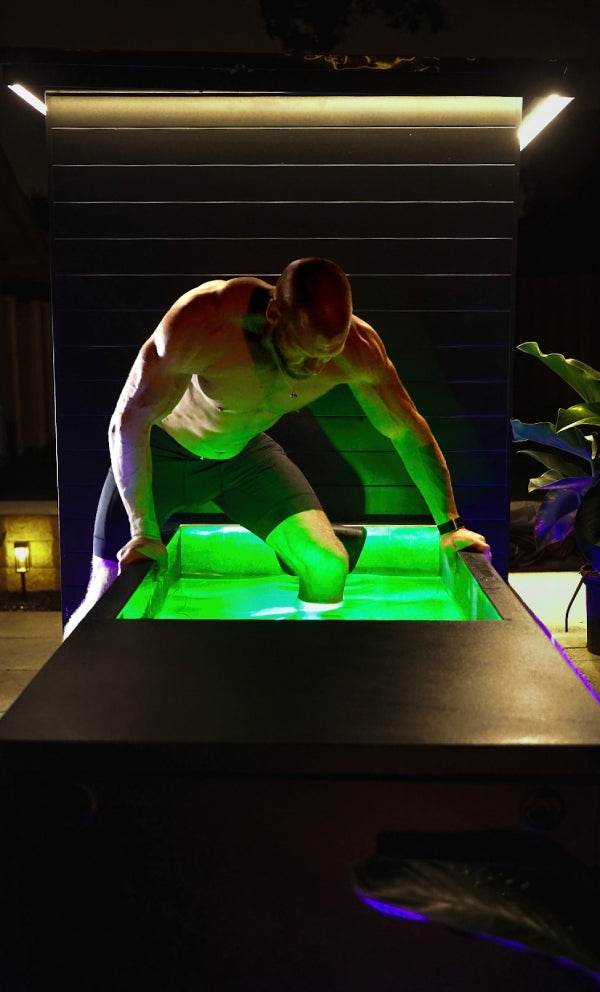
The Sun Home Cold Plunge Pro targets athletes who want colder water and lower long-term energy bills. Its 1 HP chiller can reach 32°F, according to Sun Home Saunas. That is ice bath territory without hauling bags of ice. The 100-gallon tub uses a commercial-grade insulated shell to hold temperature in hot garages. Dimensions are about 78 inches long, making it longer than the Plunge All-In. That extra length helps taller athletes extend legs without curling.
For CrossFit athletes doing two-a-days, the colder set point matters. A 2022 meta-analysis in PubMed found cold water immersion reduced muscle soreness at 24 hours, with colder temperatures producing larger effects in some subgroups. 32°F is aggressive. Most athletes will not need below 39°F often, but the headroom is useful in summer heat. Read our cold plunge protocol for beginners before setting it to 32°F.
Cons include price and footprint. The Sun Home Cold Plunge Pro runs about $4,399, sometimes more with shipping and setup. Its length can be 78 inches, which may crowd smaller garages. The chiller is also more audible than some competitors. Still, the insulation is a major upgrade if you live in Phoenix or Houston.
Key strengths:
- ✅ Cools to 32°F for ice bath temperatures
- ✅ 100-gallon insulated tub holds temps in heat
- ✅ 78-inch length suits taller athletes
- ✅ 1 HP chiller balances power and energy use
- ✅ Good for outdoor placement with proper cover
- ❌ Around $4,399 plus shipping
- ❌ Larger footprint than standard garage tubs
- ❌ Chiller noise can be noticeable in quiet spaces
Who it’s for: Taller athletes or hot-climate CrossFitters who want the coldest possible water without ice.
3. Ice Barrel 400 , Budget Ice Bath Without a Chiller
Not every CrossFit athlete has $4,000 for a chiller tub. The Ice Barrel 400 is a 105-gallon insulated barrel that costs around $1,199. It uses ice and cold tap water instead of a powered chiller. The barrel stands 42 inches high and 31 inches wide, so it fits on a back porch or apartment balcony. It weighs about 55 pounds empty. That means you can move it by yourself when not filled. The maker includes a cover and step stool.
The trade-off is effort. In summer, you may need 40 to 80 pounds of ice to bring 105 gallons from 70°F tap water down to 45°F. That gets expensive and annoying. But for a CrossFit athlete who trains at an affiliate and just wants cold immersion at home two or three days per week, this is a practical start. Our guide on cold plunge vs ice bath breaks down the cost differences.
There is no filtration or ozone. You will drain and scrub the barrel every week or two, especially if you plunge after sweaty WODs. You can also pair it later with a separate aquarium chiller, but that adds $600 to $1,200 and DIY complexity. For budget recovery, it is hard to beat.
Key strengths:
- ✅ 105-gallon capacity at a $1,199 price point
- ✅ Weighs 55 pounds empty and fits through doorways
- ✅ No electricity or plumbing required
- ✅ Insulated barrel keeps ice longer than a stock tank
- ✅ Includes cover and step stool
- ❌ Requires regular ice purchases in warm months
- ❌ No filtration or sanitization
- ❌ Water temperature control is manual
Who it’s for: Budget-focused CrossFit athletes who want a simple, portable ice bath without a chiller.
4. Renu Therapy Cold Stoic 2 , Heavy-Duty Built-In or Luxury Install
Renu Therapy builds cold plunge tanks for high-end home installations. The Cold Stoic 2 is a 98-gallon stainless steel or composite tub with a 1.5 HP chiller. It cools to 37°F and heats to 104°F, so it works for contrast therapy after heavy squat days. Dimensions are about 64 inches long, 34 inches wide, and 24 inches deep. The 1.5 HP chiller recovers temperature faster after you get in, which matters when two training partners share the tub.
This unit is not cheap. Expect to pay $6,000 to $7,000 depending on configuration. Installation may require a dedicated 20-amp circuit and floor drain. The upside is build quality. The chiller includes a 5-micron filter and ozone, plus a titanium heat exchanger. For CrossFit athletes who own a home and want a permanent recovery station next to the sauna, this is a long-term fixture.
You should not buy this if you rent or move often. It weighs several hundred pounds filled and is not portable. The app controls are straightforward, but the unit lacks the brand-name polish of Plunge. Still, the faster temperature recovery is a real performance feature. Pair it with heat sessions if you want full contrast work.
Key strengths:
- ✅ 1.5 HP chiller recovers temperature fast
- ✅ 5-micron filter and ozone keep water clean
- ✅ Cools to 37°F and heats to 104°F
- ✅ Premium stainless steel or composite construction
- ✅ Built to handle frequent daily plunges
- ❌ Price starts around $6,000
- ❌ Requires a dedicated circuit and professional setup
- ❌ Too heavy to move once filled
Who it’s for: Homeowners who want a permanent, high-flow cold plunge with fast temperature recovery.
5. Polar Monkeys Brainpod 2.0 , Portable Cold and Heat on a Mid-Range Budget
Polar Monkeys Brainpod 2.0 is a compact 90-gallon tub with a 0.8 HP chiller. It cools to 36°F and heats to 104°F. The footprint is about 67 inches long and 33 inches wide, similar to the Plunge All-In but with a lower price near $2,990. The shell is a bar-top style resin design, so it looks less clinical in a backyard or garage corner.
The price makes it a bridge between ice barrels and premium chillers. It ships with a chiller, hoses, and an insulated cover. The 0.8 HP chiller works harder in hot climates, so it may run longer during summer. For CrossFit athletes doing 4 to 5 sessions per week, the cooling speed is enough, but not exceptional. Use our how often cold plunge guide to plan weekly volume.
The main downside is support and warranty. Polar Monkeys is a smaller brand, and service quality varies. The filter is basic, and the cover does not lock in place as securely as Sun Home’s cover. Still, at under $3,000, you get true water temperature control without hauling ice.
Key strengths:
- ✅ Cools to 36°F and heats to 104°F
- ✅ 90-gallon tub under $3,000
- ✅ Compact 67-inch footprint fits garages
- ✅ Includes chiller, hoses, and cover
- ✅ Lighter than premium insulated tubs
- ❌ 0.8 HP chiller runs longer in hot weather
- ❌ Basic filter and less durable cover
- ❌ Smaller brand with variable support
Who it’s for: Athletes who want chiller-controlled cold plunge features without a $4,000 plus price tag.
Frequently Asked Questions
What temperature should CrossFit athletes use for a cold plunge?
Most CrossFit athletes respond well to water between 45°F and 55°F for 5 to 10 minutes. A tub that can reach 39°F gives you room to go colder, but you do not need 32°F every session. Start closer to 55°F and work down over weeks.
How soon after a WOD should I cold plunge?
Wait 10 to 20 minutes after training before getting in. Cold water can blunt some strength adaptations if you do it immediately after heavy lifting. Do your plunge after the session, shower, and light meal.
Can I use an ice barrel without a chiller for CrossFit recovery?
Yes. An insulated barrel like the Ice Barrel 400 works well if you are willing to add ice and change the water regularly. It costs less upfront but requires more manual effort.
How often should CrossFit athletes cold plunge per week?
Three to four times per week is enough for most athletes. You can plunge daily during competition weeks, but avoid long sessions over 15 minutes if the water is below 50°F.
Do cold plunge tubs need filtration if I shower before?
Showering helps, but it does not remove dead skin, oils, and bacteria that build up over days. A tub with a 20-micron filter and ozone or UV will stay cleaner and require less scrubbing.
Is a 39°F cold plunge safe for beginners?
It can be safe for healthy athletes, but you should start warmer and limit time to 2 to 3 minutes. Check with a doctor first if you have heart, blood pressure, or circulation issues. Never plunge alone if you are new to very cold water.
What Should You Remember?
- Cooling performance: A unit that chills to 39°F or lower gives you real cold water immersion without ice runs.
- Filtration matters: CrossFit athletes bring chalk, sweat, and grass into the tub. A 20-micron filter plus ozone is worth the cost.
- Footprint: Measure your garage bay before buying a 67 to 78 inch tub.
- Budget options: The Ice Barrel 400 works if you accept manual ice and weekly cleaning.
- Frequency: Three to four 10-minute plunges per week support recovery without overdoing cold stress.
- Safety first: Always check with a doctor if you have blood pressure or heart issues before cold plunging.
This article is for general information only and is not medical advice. Cold water immersion and sauna use can be risky for people with cardiovascular conditions, Raynaud’s disease, or who are pregnant. Always consult a physician before beginning cold therapy or heat therapy.