Every January, gyms fill up and sauna sales spike for the same reason. People want a shortcut. The appeal of heat-based weight loss is obvious. You sit still for 20 minutes, sweat through your towel, step on the scale, and it reads two pounds lighter. That number feels like progress. It is not fat loss. It is water, and it comes back the moment you drink a glass of water and eat a banana. None of that makes sauna useless for body composition. It means the mechanism people assume is happening is not the mechanism that actually helps. If you are shopping for a heat source, our best home saunas guide covers what a cabin costs in 2026.
Here is the honest version. A 30-minute sauna session raises your heart rate to somewhere between 100 and 150 beats per minute, which is comparable to a brisk walk or light cycling. Metabolic rate climbs, but only modestly. Most peer-reviewed estimates put the extra energy cost of a session at roughly 70 to 150 calories for an average adult. Some infrared brands advertise 600 calories per session. Those figures come from marketing departments, not from calorimetry chambers. For context, the same 30 minutes spent walking at 3.5 mph burns around 130 to 160 calories for a 170-pound person. Heat is not a workout replacement, and the cold plunge vs sauna statistics breakdown shows exactly how the two compare on measurable outcomes.
So why compare heat methods at all? Because they are not interchangeable, and the differences matter if you want a routine that survives past February. A traditional Finnish sauna at 180 degrees Fahrenheit and an infrared cabin at 130 degrees Fahrenheit produce very different sweat volumes, cardiovascular loads, and session lengths. A steam room at 110 degrees Fahrenheit does something different again. The Harvard Health overview of sauna research is a solid starting point for what heat does to the cardiovascular system, though fat loss is not on its list of established benefits. We evaluated five methods on five criteria: peak temperature, typical session length, measured sweat output, cardiovascular response, and how well the evidence supports any weight-related claim.
What follows is not a sales pitch for any single method. Each option below has a real use case and a real limitation. If your goal is fat loss, the heat source is a supporting actor. Your calorie deficit is the lead. If your goal is recovery, sleep quality, or simply feeling good after a hard training week, heat becomes far more interesting. One practical note before you buy anything. Heat and cold work best as a pair, and a sauna session followed by a cold plunge is one of the most studied recovery combinations in sports science. The ordering matters more than most people realize, which is why we wrote a separate guide on cold plunge before or after sauna.
How Do the Top Options Compare?
| Heat Method | Typical Temp | Session Length | Extra Calories (30 min) | Best For |
|---|---|---|---|---|
| Traditional Finnish Dry Sauna | 160-195 F | 15-20 min | 70-150 | Maximum sweat and cardiac load |
| Full-Spectrum Infrared Sauna | 120-150 F | 30-45 min | 60-120 | Long sessions at tolerable heat |
| Infrared Sauna Blanket | 120-140 F | 30-60 min | 40-90 | Smallest footprint and lowest cost |
| Steam Room (Wet Heat) | 100-115 F | 10-20 min | 50-100 | Respiratory comfort at lower heat |
| Hot Bath or Hot Tub | 100-104 F | 20-30 min | 40-80 | Passive heating with zero build-out |
Calorie figures are estimates drawn from indirect calorimetry and heart-rate modeling for a 170-pound adult. Individual output varies with body mass, fitness, hydration status, and actual cabin temperature. None of these five methods produce fat loss on their own. Every one of them requires a calorie deficit to change body composition.
1. Sun Home Nova 3-Person Indoor Traditional Sauna , Best for Maximum Sweat and Cardiac Load
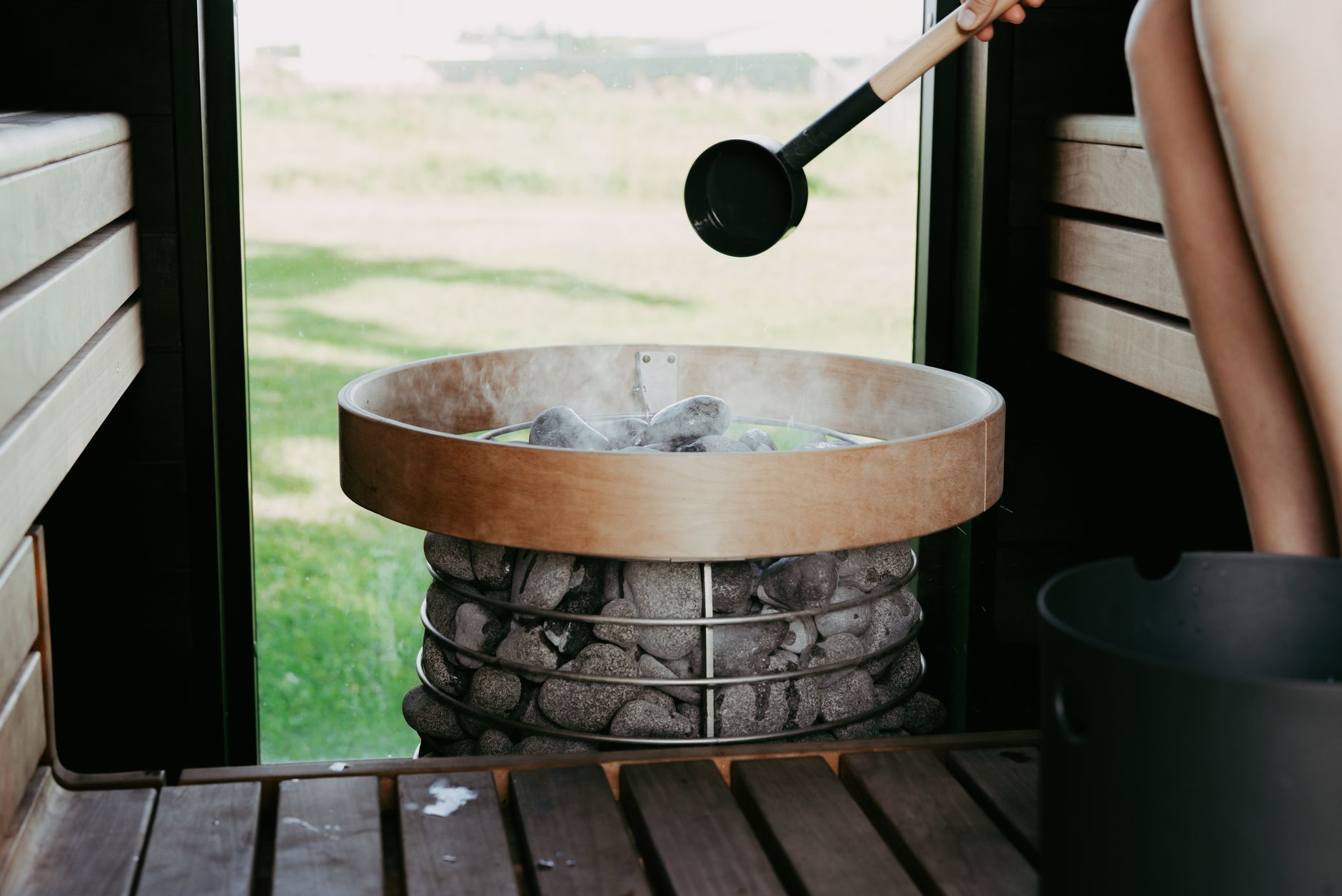
A traditional Finnish sauna runs between 160 and 195 degrees Fahrenheit at 10 to 20 percent relative humidity. That dry air is what separates it from a steam room. Within 10 minutes of sitting down, heart rate typically climbs to 100 to 150 beats per minute, a range documented in the PubMed indexed review of sauna physiology by Hannuksela and Ellahham. Core temperature rises roughly 1 to 2 degrees Celsius. You sweat 0.5 to 1.0 liters in a 20-minute session, which is exactly why the scale drops afterward.
The Sun Home Nova 3-Person Indoor Traditional Sauna is a cedar cabin built around a stone-filled electric heater. You ladle water onto the rocks for a steam burst, which spikes humidity for about 60 seconds and then settles back down. Three adults fit on the two-tier bench without shoulder contact. The heater needs 20 to 30 minutes to reach temperature from cold, so plan ahead. If you want a smaller footprint, the Sun Home Solaris Traditional Sauna (Small) is the one-person alternative.
On the weight question, the math is unflattering. A 170-pound person runs at roughly 1.5 times resting metabolic rate during a sauna session. Over 20 minutes, that adds about 50 to 90 calories. Genuine fat oxidation requires an energy deficit that heat alone will never create. What sauna does deliver, and this part is well documented, is a cardiovascular and longevity signal. Regular Finnish sauna use is associated with lower cardiovascular mortality in cohort studies, and our sauna longevity and heart health review breaks those findings down. Better heart health makes training easier. Easier training burns more calories. That is the real chain.
Track your response with a chest strap rather than guessing. A chest strap heart rate monitor survives heat and sweat far better than an optical wrist device. Cap sessions at 15 to 20 minutes, drink 500 mL before and after, and never sauna after alcohol. Dehydration is the one risk here that can genuinely hurt you.
Key strengths:
- ✅ Highest sweat output of any method here, up to 1.0 liter in a 20-minute session
- ✅ Heart rate reaches 100 to 150 bpm, the closest thing to passive cardio on this list
- ✅ Strongest body of evidence for cardiovascular and longevity benefits
- ✅ Dry 10 to 20 percent humidity feels more tolerable than a steam room to most people
- ✅ Steam bursts let you adjust intensity mid-session by ladling more water
- ❌ 160 to 195 degrees Fahrenheit is genuinely uncomfortable and not appropriate for everyone
- ❌ Negligible direct fat loss, roughly 50 to 90 extra calories per session
- ❌ Needs 20 to 30 minutes of pre-heat time plus dedicated floor space in the home
Who it’s for: Choose a traditional sauna if you want the biggest cardiovascular and sweat response and you have the space and budget for a permanent cabin.
2. Sun Home Equinox 2-Person Full-Spectrum Infrared Sauna , Best for Long Sessions at Tolerable Heat
Infrared cabins operate at 120 to 150 degrees Fahrenheit. The emitters release radiant energy that warms your body directly rather than heating the air around you. That means you can sit for 30 to 45 minutes without the distress you would feel at 190 degrees. Sweat often starts sooner, sometimes within 8 minutes, because skin temperature rises faster. Session length is where infrared earns its place. Forty-five minutes at 130 degrees produces a longer cumulative heat exposure than 15 minutes at 190 degrees, even though the peak number is lower.
The Sun Home Equinox 2-Person Full-Spectrum Infrared Sauna blends near, mid, and far infrared emitters, which is what full-spectrum means in practice. Two people fit comfortably with room to stretch legs. If you want red light LEDs built into the same cabin, the Sun Home Eclipse 2-Person Red Light + Infrared Sauna adds that layer without a second unit. Our best infrared saunas roundup covers carbon panel versus ceramic tube heaters if you are still deciding between build types.
Now the marketing problem. Infrared brands have claimed 300, 500, even 600 calories burned per session. Measured energy expenditure does not support any of those numbers. Studies using indirect calorimetry put infrared sessions at roughly 1.2 to 1.5 times resting metabolic rate, which is comparable to a traditional sauna and nowhere near a workout. If a spec sheet promises more calories than a 5K run, it is selling you a feeling, not a measurement.
Where infrared does well is adherence. A method you will use four times a week beats a method you dread. Easier sessions mean better sleep, and short sleep is one of the strongest predictors of weight gain in observational research. That is an indirect path to weight management, but it is a real one.
Key strengths:
- ✅ Tolerable at 120 to 150 degrees Fahrenheit, so sessions run 30 to 45 minutes
- ✅ Runs on standard residential power in most models with no special electrical work
- ✅ Sweat onset is faster for many users, often within 8 to 10 minutes
- ✅ Better adherence because the heat is not punishing
- ✅ Red light variants add a second modality in the same footprint
- ❌ Calorie claims of 300 to 600 per session are not supported by calorimetry data
- ❌ Lower peak heart rate than a traditional sauna, so less cardiovascular stimulus
- ❌ Full-spectrum cabins cost more than carbon panel models with similar output
Who it’s for: Choose an infrared cabin if you want long, comfortable sessions you will actually repeat and you value the red light option.
3. Sun Home Infrared Sauna Blanket , Best for Small Spaces and Low Budgets
A sauna blanket is exactly what it sounds like. A heated mat lined with infrared elements folds over your body. Operating temperature typically sits between 120 and 140 degrees Fahrenheit, and sessions run 30 to 60 minutes. You lie down the whole time, which plenty of people find far more relaxing than sitting upright on a hard bench. Sweat output is real but lower than a cabin, because your head is outside the heat and your body is not fighting gravity.
The Sun Home Infrared Sauna Blanket rolls up and slides under a bed. No electrical work, no floor space commitment, no build-out. That matters more than most buyers admit. A $400 blanket used five nights a week beats a $4,000 cabin that becomes a storage closet by March. If you are renting, this is often the only realistic heat option you have.
The tradeoffs are honest ones. There is no cardiovascular load because you are horizontal and the heat is localized to your torso and legs. Sweat volume runs lower, maybe 0.2 to 0.4 liters per session. Cleaning is a chore, since the interior absorbs sweat and needs a wipe-down every single time. People who dislike confined spaces tend to hate them. And if your goal is heat acclimation for endurance performance, a blanket will not get you there.
For pure recovery and relaxation, though, it is a legitimate tool. Twenty minutes under a blanket before bed raises skin temperature and can speed sleep onset, which is where most of the indirect weight management benefit actually happens.
Key strengths:
- ✅ Lowest entry cost of any method here, usually under $500
- ✅ Folds to the size of a duffel bag, so it works in apartments and dorms
- ✅ Runs on a standard 120V outlet with zero installation
- ✅ Works well before bed as part of a wind-down routine
- ✅ Good option if you dislike the confinement of a full cabin
- ❌ No meaningful cardiovascular stimulus because you are lying down
- ❌ Lower sweat output, roughly 0.2 to 0.4 liters per session
- ❌ Interior needs wiping after every use and the fabric degrades over time
Who it’s for: Choose a blanket if you rent, have limited space, and want heat therapy without a permanent installation.
4. Steam Room (Wet Heat) , Best for Respiratory Comfort and Joint Relief
A steam room sits at 100 to 115 degrees Fahrenheit with near 100 percent humidity. The temperature is lower than a sauna, but it feels hotter because sweat cannot evaporate off your skin. That is the entire trick. Evaporative cooling is your body’s main heat defense, and a saturated room shuts it down. You will be dripping within two minutes of walking in.
On the weight-loss question, the sweat volume looks impressive. You may drop 1 to 2 pounds on the scale after 15 minutes. It is all water and electrolytes. Drink 500 mL and it comes back. The cardiovascular heat stress is real but short, typically capped at 10 to 20 minutes before most people need to step out. Our sauna vs steam room comparison covers the physiological differences in more depth, including why the humidity number matters more than the temperature number.
Where steam wins is comfort. The moist air is easier on airways, which is why steam rooms are popular with people managing congestion or dry sinuses. Joints often feel looser afterward, though that effect is subjective and hard to quantify in a study. Where it loses is access. Most steam rooms live in commercial gyms, so you pay a membership and share the space with strangers. A qualified electrolyte powder helps replace what you lose, especially if you are training hard on the same day.
One practical caution. Heat exhaustion risk climbs fast in a steam room because dehydration and core temperature rise together. Cap sessions at 15 minutes, sit down if you feel lightheaded, and never go in alone if you have a heart condition. Standard clinical heat illness guidance applies directly here, and it is worth reading before your first session.
Key strengths:
- ✅ Lowest air temperature of any method here, 100 to 115 degrees Fahrenheit
- ✅ High humidity feels soothing to airways and sinuses
- ✅ Sweat response starts within about two minutes
- ✅ Often free with an existing gym membership and no equipment purchase
- ✅ Short 10 to 20 minute sessions fit inside a lunch break
- ❌ Near 100 percent humidity blocks evaporative cooling, so overheating happens fast
- ❌ No realistic home option without a major bathroom renovation
- ❌ Significant water and electrolyte loss with no fat loss to show for it
Who it’s for: Choose a steam room if you want respiratory relief and joint comfort and you already have gym access.
5. Hot Bath or Hot Tub (Hot Water Immersion) , Best for Passive Heating With Zero Build-Out
Hot water immersion is the cheapest heat method that still does something measurable. A bath at 102 to 104 degrees Fahrenheit for 20 to 30 minutes raises core temperature about 0.5 to 1.0 degrees Celsius. Cardiac output rises, heart rate climbs to roughly 90 to 110 bpm, and sweating kicks in once core temperature crosses your personal threshold. The Mayo Clinic recommends keeping hot tub water at or below 104 degrees Fahrenheit and limiting sessions to 15 minutes, which is a reasonable rule to carry over to a bathtub.
There is one interesting metabolic angle. Some small studies suggest repeated hot water immersion can improve glucose tolerance and insulin sensitivity in sedentary adults. The sample sizes are tiny, usually 8 to 12 participants, so treat it as a promising signal rather than a proven weight-loss strategy. Passive heating raises plasma volume and heat tolerance over weeks, which is a training adaptation, not a fat-burning one.
The cost picture is where hot water wins outright. A standard bathtub requires nothing beyond hot water, and a 30-minute bath costs roughly $0.50 to $1.00 in natural gas or electricity depending on your heater. A hot tub is a different story. Expect a 220V circuit, monthly chemical costs, and a $3,000 to $8,000 unit. If you already own one, you have a heat therapy tool sitting in the yard that you are probably underusing.
Pairing heat with cold is where the biggest practical gains show up. A sauna or hot bath followed by a cold plunge improves subjective recovery and reduces soreness, which keeps you training consistently. Training is what actually changes body composition. Our guide to cold plunge before or after sauna covers the sequencing rules, including why you should not cold plunge within 60 minutes of a strength session.
Key strengths:
- ✅ Zero equipment cost beyond a bathtub you already own
- ✅ Raises core temperature and heart rate with no skill required
- ✅ Clinical guidance caps hot tub water at 104 degrees Fahrenheit, a clear safe limit
- ✅ Repeated use improves heat tolerance and plasma volume over weeks
- ✅ Pairs naturally with cold plunge for contrast recovery work
- ❌ Lowest peak cardiovascular load of the five methods
- ❌ Hot tubs carry real chemical, electrical, and maintenance costs
- ❌ Long baths dry out skin and can cause lightheadedness on standing
Who it’s for: Choose a hot bath if you want passive heat therapy tonight with no purchase, no installation, and no learning curve.
Frequently Asked Questions
Does sauna actually burn fat?
No. A sauna raises metabolic rate modestly, adding roughly 70 to 150 calories over a 30-minute session for an average adult. Fat loss requires a sustained calorie deficit. Any pounds that disappear right after a sauna are water and return with rehydration.
How much weight can you lose in one sauna session?
A 170-pound adult typically drops 1 to 3 pounds on the scale after 20 minutes of intense sweating. That is almost entirely sweat and electrolyte loss. Drinking 500 to 750 mL of water restores it within an hour or two.
Is infrared sauna better than traditional sauna for weight loss?
Neither produces meaningful fat loss. Infrared cabins run cooler at 120 to 150 degrees Fahrenheit and let you sit for 30 to 45 minutes, while traditional saunas at 160 to 195 degrees Fahrenheit push heart rate higher. Choose the one you will actually use four times a week.
Can sauna help with weight management indirectly?
Yes, through sleep and recovery. Short sleep is one of the strongest predictors of weight gain in observational research, and a consistent evening heat routine can improve sleep onset. Faster muscle recovery also keeps your training volume steady.
How often should you use a sauna for the best results?
Two to four sessions per week of 15 to 20 minutes is the range most associated with cardiovascular benefits in cohort studies. Daily use is common in Finland and generally safe for healthy adults who hydrate properly.
Is it safe to sauna while trying to lose weight?
For most healthy adults, yes. The real risks are dehydration and overheating. Drink water before and after, avoid alcohol entirely, and step out immediately if you feel dizzy. Anyone with a heart condition or taking diuretics should clear it with a doctor first.
What Should You Remember?
- Water weight is not fat loss. A sauna can drop the scale 1 to 3 pounds in 20 minutes, and rehydration brings every ounce back.
- A 30-minute session burns 70 to 150 extra calories. That is roughly a 15-minute walk, not a workout.
- Traditional saunas run 160 to 195 degrees Fahrenheit and drive heart rate to 100 to 150 bpm, the strongest passive cardiovascular stimulus of the five methods.
- Infrared cabins at 120 to 150 degrees Fahrenheit win on adherence. Long, tolerable sessions you repeat beat brutal sessions you skip.
- Claims of 600 calories per infrared session are marketing. Indirect calorimetry puts real output at 1.2 to 1.5 times resting metabolic rate.
- Sauna supports weight management indirectly. Better sleep and faster recovery keep you training, and training is what changes body composition.
- Hydrate or the heat turns on you. Replace 500 to 750 mL per session plus electrolytes, and never sauna after drinking alcohol.
This article is for general information only and is not medical advice. Cold water immersion and sauna use can be risky for people with cardiovascular conditions, Raynaud’s disease, or who are pregnant. Always consult a physician before beginning cold therapy or heat therapy.