⚡ Quick Answer
For most buyers, the Dundalk Leisurecraft Canadian Timber series ($3,500–$6,000) is the gold standard — real Canadian red cedar, Harvia heaters, and a 20+ year lifespan. Mid-range pick: the Almost Heaven Georgian Barrel (~$2,800) delivers solid quality at a more accessible price. Budget pick: Aleko BETA4 (~$1,400) gets you a functional 2-person barrel without breaking the bank. Before you buy, read the heater and electrical sections below — a 240V circuit installation often adds $300–800 to your project cost and surprises first-time buyers.
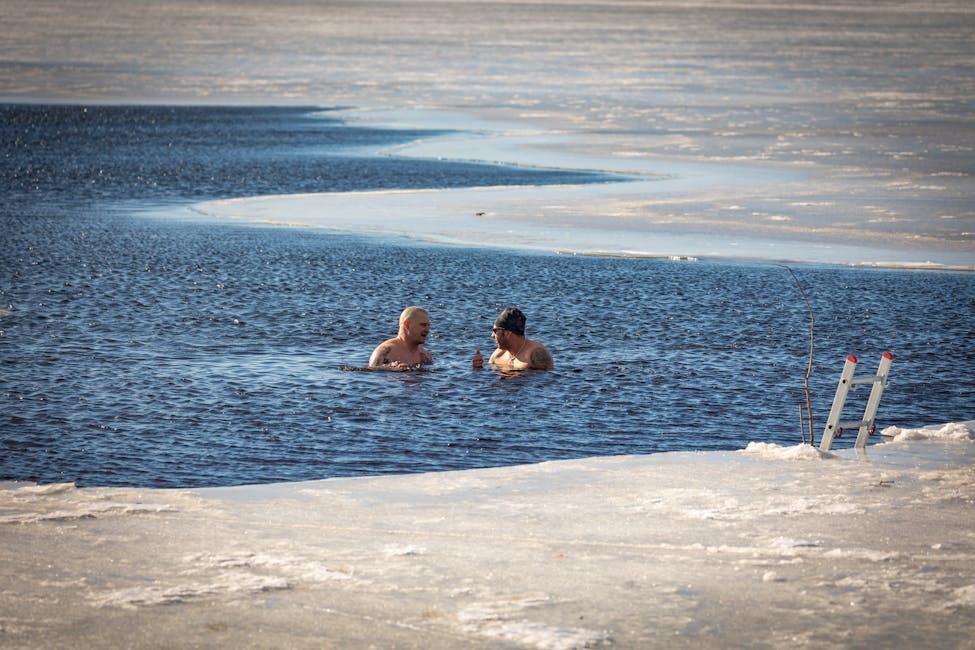
Why Barrel vs Traditional Box Sauna?
The barrel shape isn't just an aesthetic choice — it creates a genuine functional advantage. Here's what's actually happening inside a cylindrical sauna that doesn't happen in a flat-walled box:
Superior convection. Curved walls channel rising hot air in a continuous loop rather than allowing it to pool unevenly near the ceiling. The result is more consistent temperature from floor to ceiling — typically within 10–15°F variation in a barrel vs 30–40°F in a comparable box sauna. You get full-body heat faster and more evenly.
Smaller interior volume per person. A barrel sauna's curved interior means less cubic footage of air to heat compared to a rectangular room with the same floor footprint. A 6'×7' barrel reaches target temperature (170–185°F) 15–25% faster than an equivalent box sauna — saving wood or electricity every session.
Structural strength without framing. Barrel saunas are built like wine barrels: interlocking stave construction held in tension by steel hoops. There's no internal framing to rot, and the design handles enormous snow loads — the curved roof sheds precipitation naturally without adding structural complexity.
Year-round outdoor installation. Barrel saunas are purpose-built for exposure. The curved profile has no flat horizontal surfaces to pool water. Cedar and thermowood models survive decades of freeze-thaw cycles that would crack a conventionally framed structure.
The main trade-off: you lose floor space to the curve. A 6' diameter barrel has usable bench width of about 4'6" — some users find this cramped for lying down. If you want to stretch out fully or use a sauna for yoga-style floor poses, a pod or cabin sauna gives you more flat floor area.
Research confirms what generations of Finnish sauna users already knew: regular sauna use is genuinely good for you. A landmark 2015 study by Laukkanen et al. in JAMA Internal Medicine followed 2,315 Finnish men over 20 years and found that those using a sauna 4–7 times per week had a 40% lower risk of fatal cardiovascular events compared to once-weekly users. If you're going to invest $1,500–6,000 in a backyard wellness structure, the research supports making it a habit.
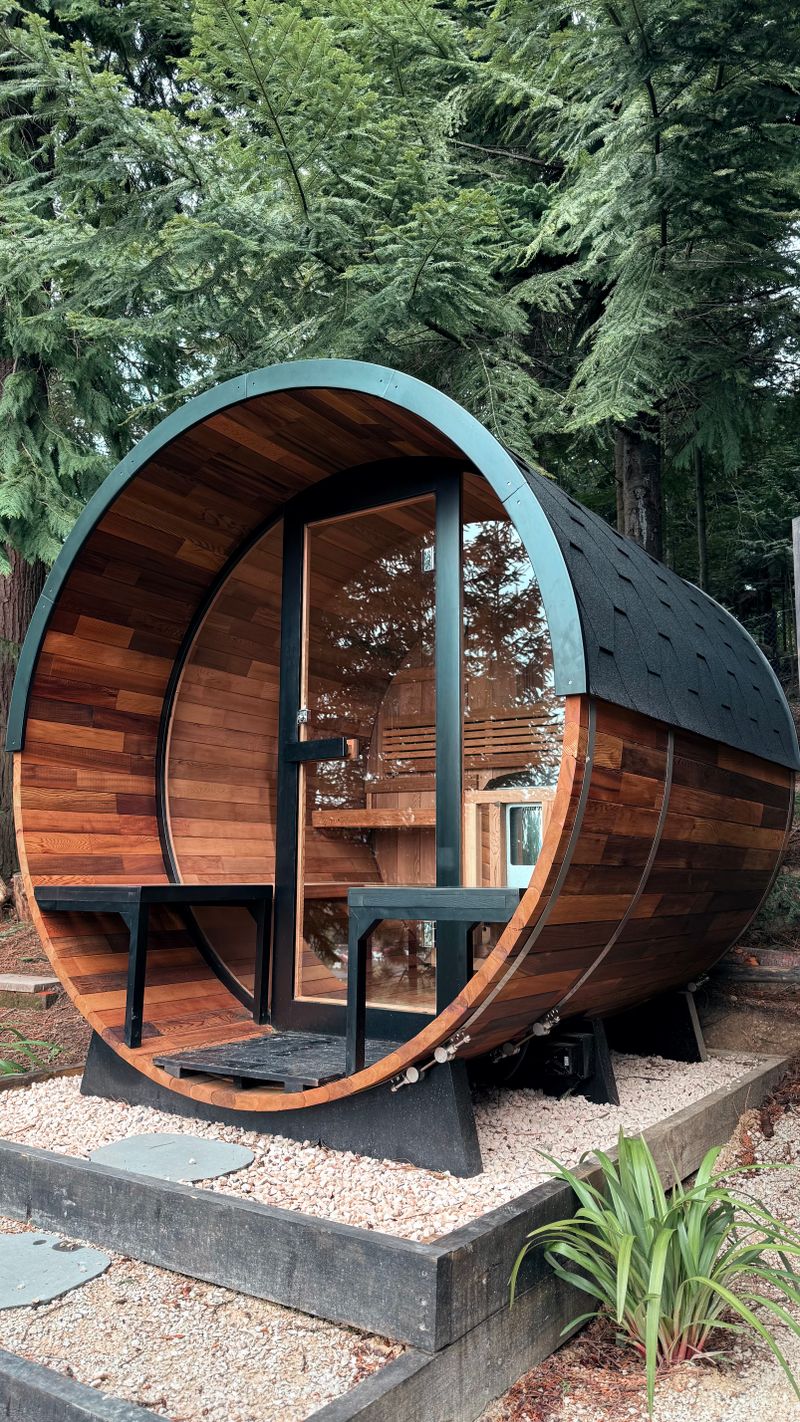
Wood Types: Cedar, Hemlock, Thermowood, and Spruce
Wood selection is the most confusing part of buying a barrel sauna — and the most important for long-term satisfaction. Here's an honest breakdown of what the marketing copy often glosses over:
Western Red Cedar
The premium standard for outdoor saunas. Cedar's natural aromatic oils (thujaplicins) are antibacterial and resist rot, insects, and moisture without chemical treatment. It handles wet-dry cycles without warping or cracking, and the distinctive cedar scent intensifies during sessions in a way many users find deeply relaxing. Lifespan outdoors: 20–30 years with basic annual oiling. Downside: it's the most expensive wood option, adding $500–1,500 to comparable sauna pricing. Best for: most climates, buyers who want to buy once and forget it.
Canadian Hemlock
The most common "budget" sauna wood that isn't actually budget in quality. Hemlock is denser than cedar, holds heat well, and doesn't have the strong aromatic oils that can bother sensitive users. It's naturally light-colored and stays clean-looking longer than cedar. It lacks cedar's natural pest resistance, so it benefits more from annual sealing. Lifespan: 15–20 years with maintenance. Best for: users sensitive to cedar aroma, slightly cooler or drier climates, buyers keeping costs under $2,500.
Thermowood (Heat-Treated Spruce or Pine)
Thermally modified wood is regular spruce or pine that's been kiln-treated at 185–215°C in a low-oxygen environment. The process caramelizes the wood sugars, dramatically reducing moisture absorption — modified wood absorbs 50% less water than untreated wood. The result is exceptional dimensional stability (less warping and cracking over time) and improved rot resistance without chemical preservatives. It's darker-toned (similar to walnut), which some buyers prefer aesthetically. More expensive than hemlock, slightly less than cedar. Best for: humid climates, rainy Pacific Northwest or coastal environments, buyers who hate maintenance.
Nordic Spruce and Pine
Traditional Finnish sauna wood. Light in color, affordable, and performs adequately when the sauna is covered or under a roof. Untreated spruce and pine absorb water readily and require more frequent maintenance than cedar or thermowood — expect to oil annually minimum, and consider a UV-protective exterior sealer. Fine for covered installations or those who are diligent about maintenance. Best for: covered installations, buyers with tight budgets, traditional aesthetic preference.
| Wood | Rot Resistance | Maintenance | Aroma | Lifespan (outdoor) | Relative Cost |
|---|---|---|---|---|---|
| Western Red Cedar | Excellent — natural | Low (oil annually) | Strong, distinctive | 20–30 years | Premium |
| Canadian Hemlock | Good — seal recommended | Moderate | Minimal | 15–20 years | Mid |
| Thermowood | Very good — modified | Low | Very mild | 20–25 years | Mid-Premium |
| Nordic Spruce/Pine | Fair — needs treatment | High | Light, clean | 10–15 years | Budget |
Heater Options: Electric vs Wood-Burning
Your heater is the heart of your sauna — and the decision between electric and wood-burning has real practical implications beyond "which feels more authentic."
Electric Sauna Heaters
Electric heaters are the dominant choice for residential barrel saunas for good reason: no chimney flue, no wood storage, no fire maintenance during sessions, and precise temperature control. Most residential units are 4–9kW:
- 4–6kW: Adequate for 1–2 person saunas up to ~180 cu ft interior volume
- 6–9kW: Required for 3–4 person or larger barrel saunas (6'×8' and up)
- 9kW+: Commercial-grade, rarely needed for backyard barrels
Electric heaters require a dedicated 240V/30A–50A circuit — this is non-negotiable and often surprises buyers (see the Electrical Requirements section). The heater itself is straightforward to use: dial in your temperature, wait 30–45 minutes, enjoy.
Brands to trust: Harvia (Finnish, industry standard), Tylo (Swedish, premium), HUUM (Estonian, elegant design). Avoid no-name heaters from generic marketplaces — safety certification (UL or ETL) matters when you're running 240V equipment in a wet environment.
Wood-Burning Sauna Stoves
Wood-burning delivers the authentic Finnish löyly experience — higher stone mass, more steam, temperatures reaching 195–210°F if you push it. The ritual of building a fire is itself part of the experience for many users. Practical considerations:
- Requires a chimney flue through the barrel roof (typically included in DIY kits)
- Takes 45–70 minutes to reach temperature (longer in cold weather)
- Continuous fire management during use (add wood every 30–45 minutes)
- Some municipalities restrict wood-burning in residential areas — check local bylaws
- Requires a dry wood supply (seasoned hardwood, stored nearby)
- No electricity required — ideal for off-grid installations
For buyers who want the ritual and can tolerate the setup, wood-burning is genuinely superior in experience. For buyers who want to "push a button and be in a hot sauna in 40 minutes," electric is the right call.
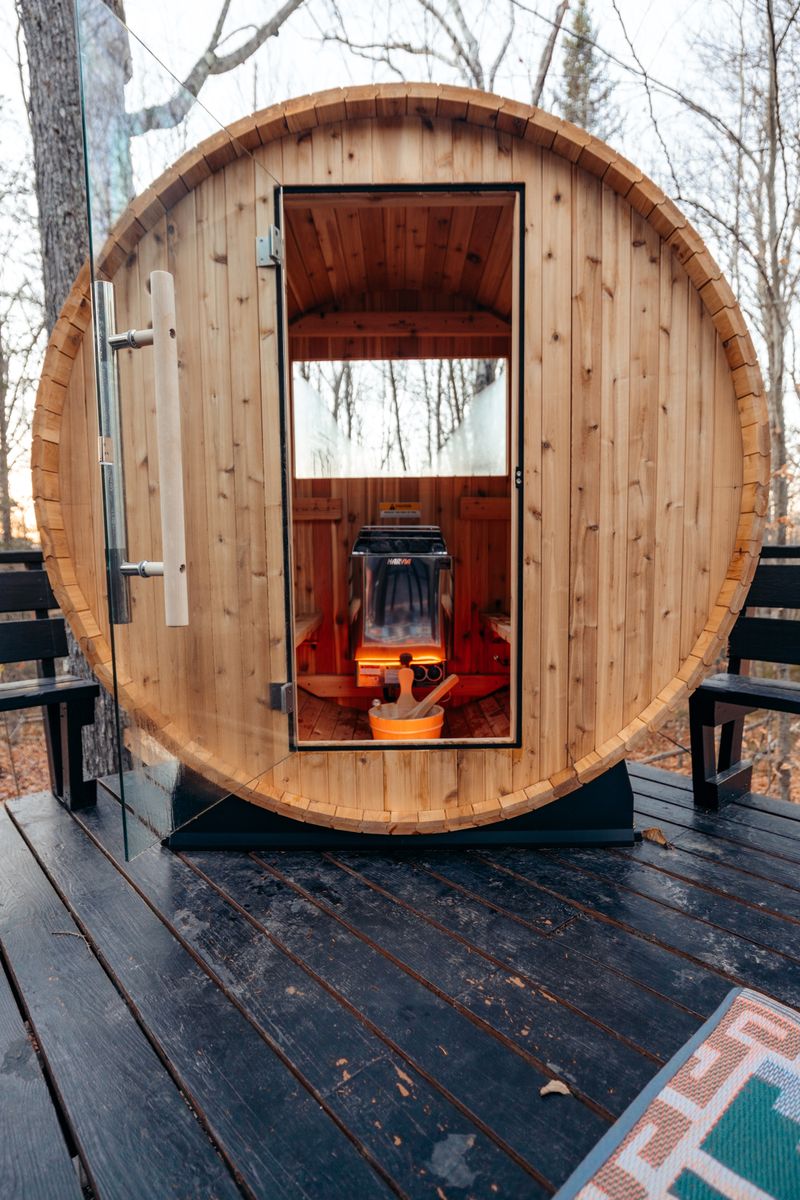
Top Barrel Saunas: Comparison Table
| Model | Price | Size (dia × len) | Capacity | Wood | Heater Included | Assembly Time |
|---|---|---|---|---|---|---|
| Aleko BETA4 | ~$1,400 | 4.6' × 6' | 1–2 person | Spruce/Fir | Electric (6kW) | 4–6 hrs |
| Radiant Saunas BSA2418 | ~$1,700 | 4.9' × 6' | 2 person | Hemlock | Electric (6kW) | 4–6 hrs |
| Almost Heaven Pinnacle | ~$1,899 | 4.9' × 6' | 2 person | Hemlock | Electric (6kW) | 4–6 hrs |
| Almost Heaven Georgian | ~$2,799 | 6' × 7' | 4 person | Hemlock/Cedar | Electric (8kW) | 6–8 hrs |
| Dundalk Georgian Barrel | ~$3,200 | 6' × 7' | 4 person | Red Cedar | Electric (Harvia) | 6–8 hrs |
| Dundalk Canadian Timber Harmony | ~$4,999 | 6' × 7' | 4 person | Red Cedar | Electric (Harvia) | 6–8 hrs |
Budget Pick: Aleko BETA4 (~$1,400)
Aleko BETA4 Barrel Sauna
- Lowest entry price for a real outdoor barrel sauna
- Ships with electric heater included — no extra purchase needed
- Panelized assembly designed for solo or pair DIY
- Good for covered decks or garages where wood protection is less critical
The Aleko BETA4 is honest about what it is: a budget entry point into barrel sauna ownership. Spruce and fir are softer woods that will need more maintenance outdoors — plan on oiling annually with a UV-protective exterior finish. For a covered patio or under a pergola, the wood protection requirements drop significantly. At $1,400 with a heater included, this is the clearest path to trying barrel sauna ownership without $3,000–5,000 commitment.
Mid-Range Picks: Almost Heaven & Dundalk Georgian (~$1,899–$3,200)
Almost Heaven Georgian Barrel Sauna
- Full 4-person capacity at under $3,000
- Canadian hemlock — more durable than spruce/fir, no strong aroma
- 8kW heater adequate for larger barrel volume
- Available with optional wood-burning stove upgrade
- Ships pre-assembled in panels — full assembly in one day
The Georgian hits the sweet spot that most buyers land on after doing their research. It's big enough for family use or entertaining, the hemlock holds up well outdoors, and the 8kW heater doesn't leave you waiting forever. Almost Heaven is a U.S.-based company with good customer service reputation and replacement parts availability.
Dundalk Georgian Barrel Sauna
- Real Canadian red cedar — superior rot resistance, aromatic oils
- Harvia heater is the industry standard (reliable, parts widely available)
- Dundalk is a Canadian company with decades in outdoor sauna construction
- Clear cedar benches and interior finishing (no knots to burn against)
Premium Pick: Dundalk Canadian Timber Series (~$4,999–$6,000)
Dundalk Leisurecraft Canadian Timber Harmony
- Furniture-grade Canadian red cedar throughout — interior and exterior
- Harvia heater with digital controls included
- Changing room porch option available (useful for winter climates)
- Ships in pre-assembled panels — 2 adults can complete in one day
- 25+ year expected lifespan with annual oiling
- Dundalk makes their own replacement parts — truly buy-it-once quality
The Canadian Timber Harmony is the product buyers consistently come back to after shopping the category. The cedar quality is noticeably superior when you unbox it — grain is tight, color is rich, and there's no filler or paint hiding lesser wood. The Harvia digital heater means precise temperature control with a timer. For buyers spending $5,000 on a backyard wellness structure, the Dundalk is the version that won't need replacing in 10 years.
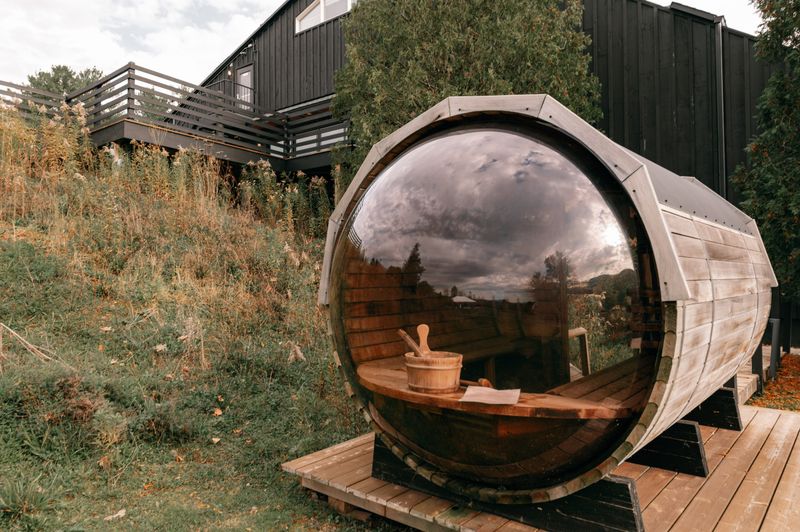
Assembly Reality Check
Every barrel sauna manufacturer markets these as "easy DIY" builds. That's technically true but leaves out important context. Here's what to actually expect:
You will need two people. Panel sections weigh 40–80 lbs each, and aligning stave rings to the cradle base requires one person holding and one person fastening. Solo builds are possible but frustrating and risk damaging the wood when panels drop.
Plan for a full day, not an afternoon. The "4–6 hour assembly" times on spec sheets assume experienced builders with all tools pre-staged. For first-time assemblers: add 30–50% to any published time estimate. A full-day Saturday build with a helper is a realistic expectation for most kits.
Tools you'll need:
- Power drill + bits (most kits use 3/8" lag bolts for cradle assembly)
- Rubber mallet (seating staves and floor panels without marring)
- Level (critical — a sauna on uneven ground puts stress on the hoops)
- Adjustable wrench for tightening steel bands
- Caulk gun (exterior seam sealing)
- Circular saw or jigsaw if any site-specific trimming is needed
Foundation options: Barrel saunas sit on two cradle bases (C-shaped wooden or metal rockers) that transfer load to the ground. Your foundation options are:
- Deck blocks on compacted gravel: Easiest, most common. 4–6 deck blocks set in 4" of crushed gravel provides drainage and stability. No permits usually needed.
- Existing deck or patio: Verify load rating. A 6'×7' cedar barrel with a stone-filled heater weighs 600–900 lbs loaded. Most residential decks handle this fine, but check your joists.
- Concrete pad: Best long-term option, required by some municipalities. Adds $300–600 in materials or $800–1,500 if you hire a contractor. Overkill for most residential installs.
When to hire help: If you're not comfortable with basic carpentry, electrical rough-in, or if your site has significant slope (more than 4"), hiring a handyman for the day ($300–500) is money well spent. Dundalk and Almost Heaven both maintain lists of certified installers.
Electrical Requirements
This is the most common surprise cost in a barrel sauna purchase, and it's worth understanding before you buy.
Almost all electric sauna heaters require a dedicated 240V circuit. This is the same voltage as your clothes dryer or electric oven — not a standard 120V household outlet. Your panel will need an open breaker slot (typically 30A for smaller heaters, 40–50A for larger models), and you'll need a licensed electrician to run conduit from the panel to the sauna location.
Typical electrician cost: $300–800 depending on distance from panel to sauna, local labor rates, and whether conduit needs to run underground or through finished walls. In rural areas or where the sauna is close to the panel, it's often on the lower end. Urban areas or long runs can push past $1,000.
What the run requires:
- 10/2 or 8/2 wire depending on amperage (your heater's spec sheet will specify)
- GFCI protection at the disconnect (required by NEC for outdoor/wet locations)
- Weatherproof disconnect switch within sight of the sauna
- Outdoor-rated conduit where exposed
Don't skip the electrician to save money. Sauna heaters in wet environments with improper wiring are a genuine fire and electrocution risk. This is not a DIY-if-you're-handy situation — it requires a licensed professional and a permit in most jurisdictions.
Wood-burning alternative: If you want to avoid the electrical cost entirely, a wood-burning stove eliminates the 240V requirement. You'll still need a chimney flue kit (~$100–200), and you'll need to check local fire codes, but the absence of an electrician visit significantly lowers total project cost.
Weatherproofing & Maintenance
A barrel sauna that's properly maintained will outlast its owners. One that's neglected for a few years will need significant work. Here's the maintenance reality:
Annual Tasks
- Exterior oiling: Apply a UV-protective wood oil or exterior sauna finish to all exterior staves. This prevents greying, checking (surface cracks), and UV degradation. Cedar is forgiving — even greyed cedar can be rejuvenated with a fresh oil coat after light sanding. Do this every 12–18 months depending on sun/rain exposure.
- Drain plug check: Every barrel sauna has a floor drain. After each use, open or remove the drain plug to let moisture escape. If you close a damp barrel and walk away for a month, you'll have mold. This is the most common mistake new owners make.
- Heater stone check: Sauna stones degrade over time from thermal cycling. Cracked or crumbling stones don't hold heat efficiently and can pop dangerously when water is poured. Replace the full stone set every 2–3 years (cost: $40–80).
- Hoop tension: Steel bands hold the barrel together. Check tension annually — you should not be able to slide a hoop significantly with hand pressure. Tighten the adjustment bolts if needed. This is a 10-minute job.
Every-Few-Years Tasks
- Interior bench sanding: Bench surfaces darken from oils and use. Light sanding with 120-grit paper followed by an interior-safe sauna wax keeps them comfortable and looking fresh.
- Flue cleaning (wood-burning models): Clean the chimney flue annually to remove creosote buildup. A blocked flue is a fire hazard. Use a chimney brush sized to your flue diameter.
- Heater element check (electric models): Electric heaters last 10–20 years with normal use. Check that all elements are heating evenly — a cold spot indicates a failed element. Replacement elements are typically $80–150.
The payoff for this maintenance is measured in decades. A well-cared-for Dundalk cedar barrel is realistically a 25-year structure. Neglect the basics and you're looking at significant repairs in 7–10 years.
Frequently Asked Questions
Can a barrel sauna stay outside year-round?
Yes — barrel saunas are built for permanent outdoor installation. Cedar and thermowood models handle Canadian winters, heavy snow loads, and humid summers without issue. The curved roof sheds rain and snow naturally. Apply a UV-protective exterior oil once a year and open the drain plug when not in use to prevent moisture buildup. With basic care, a quality barrel sauna lasts 20–25 years outdoors.
How long does a barrel sauna take to heat up?
Electric heaters typically reach 170–185°F in 30–45 minutes. Wood-burning stoves take 45–70 minutes depending on wood quality, fire management, and ambient temperature. The barrel shape's smaller interior volume actually speeds heat-up compared to a box sauna of equivalent footprint — less air mass to heat. In cold weather (below 20°F), add 10–15 minutes to either estimate.
Do I need a permit for a barrel sauna?
Permit requirements vary by municipality. Most jurisdictions require a permit if the structure exceeds 100–120 sq ft or includes permanent electrical work (240V circuit). A small 2-person barrel sauna with a wood-burning stove often falls below thresholds. Always check your local building department before installation — some areas also require setback distances from property lines. The electrical permit (separate from the structure permit) is almost always required regardless of sauna size.
How long do barrel saunas last?
Quality cedar or thermowood barrel saunas last 20–30 years with basic annual maintenance. Spruce or pine models last 10–15 years if oiled regularly, less if neglected. The main failure points are the floor staves (constant moisture exposure) and the heater — both can be replaced individually without replacing the whole barrel. Dundalk and Leisurecraft offer replacement parts for their entire product history.
Can I install a wood-burning heater in a barrel sauna?
Yes — most barrel saunas are designed to accept either electric or wood-burning heaters, and many manufacturers offer both configurations. Wood-burning requires a roof-penetrating chimney flue, proper spark arrestor, and clearance from combustibles inside the barrel. Some municipalities restrict open-fire installations in residential areas — check local codes before buying a wood-burning unit. Installation typically adds $200–500 to the project cost beyond the heater price itself.
What foundation does a barrel sauna need?
The simplest and most common foundation is two wooden or metal cradle rockers set on 4–6 concrete deck blocks over a 4" compacted gravel bed. This provides drainage, prevents ground contact, and requires no concrete work or permits in most areas. For permanent installs or areas with frost heave, a small concrete pad is ideal. Avoid setting the cradles directly on bare dirt — ground contact will accelerate wood rot at the base points regardless of wood species.
Get weekly guides from PlungeHQ
No spam. Unsubscribe anytime.