
Most people who start cold plunging assume the colder, the better. It's intuitive: ice bath sounds extreme, therefore more extreme = more effective. But that's not what the physiology shows. There is a temperature-response relationship with a clear threshold — below a certain point, you're adding cardiovascular stress and hypothermia risk without meaningfully increasing benefits. Understanding where that threshold sits, what happens in each temperature zone, and how to actually hit your target temperature with the setup you have will make you a smarter, safer, and more effective cold plunge practitioner.
This guide covers everything: the four temperature zones and what each one actually does to your body, what the research says about dose-response, how to achieve target temperatures across five different setups, how body composition and season affect your experience, when to get out, and what tools to use to measure what you're actually doing.
The Four Temperature Zones
Not all cold is the same. The difference between 65°F and 50°F is not just a matter of discomfort — it's a fundamentally different physiological stimulus. Here's how to think about the four distinct zones and what each one does to your body.
Zone 1: 60–68°F (15–20°C) — The Cold Comfort Zone
Who it's for: Complete beginners, people with cardiovascular sensitivities, older adults easing into cold exposure.
What it feels like: Cool to cold. Uncomfortable for the first 30–60 seconds but not shocking. Breathing remains relatively controlled. You can hold a conversation. Most people tolerate this range within their first few sessions without significant distress.
What it does physiologically: At this range, you get mild vasoconstriction, a modest norepinephrine response, and some cold adaptation stimulus. The cold shock response — the sharp gasping and involuntary hyperventilation that characterizes true cold water immersion — is present but mild. This zone works well for mental practice (learning breath control, tolerating discomfort) and has some mood and circulation benefits, but it's not the primary research zone for maximum catecholamine release.
Bottom line: Real benefits, manageable risk, appropriate starting point for most new practitioners. Don't dismiss it — 65°F genuinely is cold.
Zone 2: 50–59°F (10–15°C) — The Research Zone
Who it's for: The vast majority of cold plunge practitioners. This is the target for most protocols.
What it feels like: A sharp, genuine cold shock on entry. Involuntary gasping. The urge to breathe rapidly. Heart rate spikes immediately. After 60–90 seconds of controlled breathing, the intensity becomes manageable but remains demanding throughout the session.
What it does physiologically: This is where the research lives. The landmark Šrámek et al. (2000) catecholamine study used 14°C (57°F) and found norepinephrine increases of 200–300% and dopamine increases of up to 250%. Vasoconstriction is maximal in this range, driving blood from the periphery to protect core organs. Brown adipose tissue activation ramps up. The anti-inflammatory cascade studied for DOMS reduction in athletes operates most effectively here.
Bottom line: The sweet spot. If you only remember one number, remember 50–59°F. This is where the science is and where the benefits are.
Zone 3: 45–50°F (7–10°C) — Performance Cold
Who it's for: Serious athletes and experienced cold therapy practitioners with months of consistent adaptation behind them.
What it feels like: Intense. The cold shock response is near-maximal. Fine motor control degrades quickly. Speech may become difficult within a few minutes. Fingers and toes go numb fast.
What it does physiologically: Anti-inflammatory effects are maximized at this range — particularly relevant for high-volume training athletes dealing with significant muscle damage and inflammation. Vasoconstriction is more aggressive, which can accelerate flushing of metabolic waste from muscle tissue. However, the additional benefit over Zone 2 is incremental, not dramatic. If Zone 2 produces an 8/10 physiological response, Zone 3 might produce an 8.5–9/10. The question is whether that marginal gain is worth the substantially higher physical stress.
Bottom line: Appropriate for cold-adapted practitioners chasing marginal gains. Not a shortcut — it requires weeks of Zone 2 adaptation first.
Zone 4: 35–44°F (2–7°C) — Extreme Cold
Who it's for: Advanced cold water swimmers, ice bath competitors, and clinical settings only. Not general use.
What it feels like: Immediate, overwhelming cold shock. Gasping and hyperventilation are uncontrollable for the first 60+ seconds even in experienced practitioners. Extremity function degrades within 2–3 minutes. Risk of cold incapacitation is real.
What it does physiologically: Diminishing returns territory for health benefits. The catecholamine response is not meaningfully higher than at Zone 3 — it saturates. What does increase is cardiovascular stress, hypothermia risk, and the danger of cold incapacitation (where the body loses the ability to coordinate movement in cold water — the mechanism behind cold water drowning). Maximum safe exposure at these temperatures for most adults is 1–2 minutes.
Bottom line: Do not target this zone for health optimization. Ice water range is for specific athletic protocols under supervision, not general cold plunge practice.
| Temperature Zone | Range | Physiological Response | Appropriate For |
|---|---|---|---|
| Cold Comfort Zone | 60–68°F (15–20°C) | Mild cold shock, modest norepinephrine response, early vasoconstriction | Beginners, cardiovascular sensitivities |
| The Research Zone | 50–59°F (10–15°C) | Full cold shock response, 200–300% norepinephrine spike, strong vasoconstriction, maximum adaptation stimulus | Most practitioners — target range |
| Performance Cold | 45–50°F (7–10°C) | Near-maximal cold shock, aggressive vasoconstriction, peak anti-inflammatory effect, significant fine motor degradation | Cold-adapted athletes only |
| Extreme Cold | 35–44°F (2–7°C) | Maximal cold shock, rapid incapacitation risk, hypothermia with extended exposure, diminishing health returns | 1–2 min max; advanced protocols only |

What the Research Says: Does Colder = Better?
The short answer is no — and it's worth understanding exactly why, because it contradicts the intuition most people bring to cold plunging.
The Catecholamine Study That Started It All
The most cited temperature study in cold water immersion research is Šrámek et al. (2000), published in the European Journal of Applied Physiology. Researchers measured catecholamine responses (norepinephrine, epinephrine, dopamine) in subjects immersed in cold water at 14°C (57°F). The results were striking: norepinephrine increased by approximately 200–300%, dopamine by up to 250%. These neurochemicals are associated with alertness, mood, motivation, and pain tolerance — which explains why people reliably report feeling significantly better after a cold plunge.
What the study also shows, and what's often omitted in popular reporting, is that 14°C (57°F) was sufficient to trigger a near-maximal catecholamine response. The implication: going to 45°F does not produce twice the norepinephrine response compared to 57°F. The response curve is not linear — it saturates.
Tipton and the Cold Shock Response Threshold
Mike Tipton's research on cold shock (the involuntary cardiorespiratory response to sudden cold water immersion) establishes that the response is largely triggered at the skin-level temperature change, not by absolute temperature. The shock response — gasping, hyperventilation, heart rate spike — begins activating around 15°C and reaches near-maximal intensity by approximately 10°C. This means that going from 50°F to 45°F doesn't dramatically increase the cold shock stimulus; it mainly increases the duration and cardiovascular load.
The DOMS Research and Athletic Recovery
Bleakley et al. (2012), the Cochrane systematic review of cold water immersion for exercise-induced muscle damage and DOMS, analyzed multiple trials using various temperatures. The review found consistent evidence of DOMS reduction and recovery improvement, but the studies used temperatures ranging from 10–15°C across different protocols. There is no strong dose-response evidence in this literature showing that 45°F produces meaningfully better DOMS outcomes than 55°F for the same duration. The mechanism — vasoconstriction reducing inflammatory cytokine accumulation — operates throughout the Zone 2 range.
The Honest Takeaway
The research does not support chasing extreme cold. The catecholamine response saturates around 50–57°F. The anti-inflammatory effect for athletic recovery operates across the full Zone 2 range. The cold shock response reaches near-maximal intensity by 50°F. Going to 40°F adds meaningful cardiovascular risk and hypothermia risk with marginal physiological return. For most practitioners, the optimal protocol is not the coldest possible — it is consistent Zone 2 exposure at a temperature you can safely sustain for 2–5 minutes, 3–5 times per week.

How to Hit Your Target Temperature (By Setup)
Knowing your target temperature and actually hitting it are two different problems. Here's how to achieve Zone 2 temperatures with five common setups.
Standard Bathtub
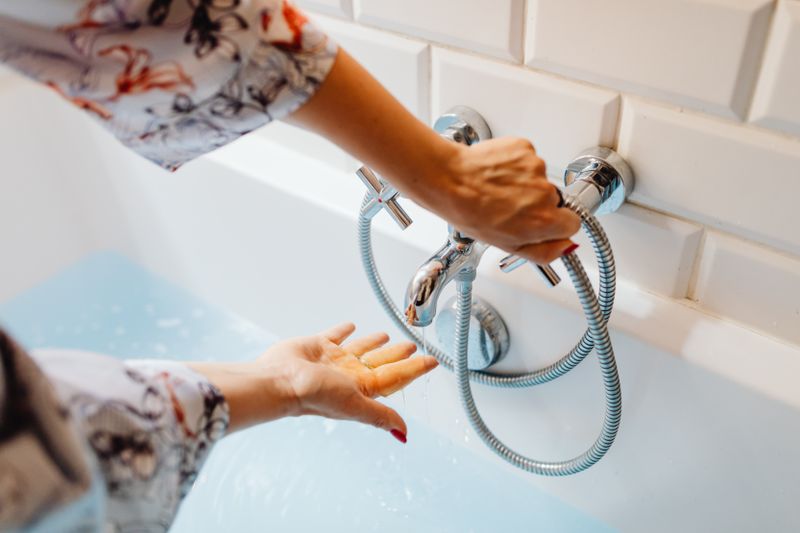
Cold tap water temperature varies significantly by season and geography (more on that below), but in most North American homes it ranges from 45–65°F. In summer, you may find yourself at 60–65°F straight from the tap — borderline Zone 1/2. In winter, northern homes often get tap water at 45–50°F, which puts you squarely in Zone 2 without any ice. To lower temperature with ice: as a rule of thumb, 1 lb of ice will drop approximately 1 gallon of water by about 1°F as it melts. A standard bathtub holds roughly 40–50 gallons; getting from 65°F to 55°F requires approximately 400–500 lbs of ice — which is why ice delivery for bathtub plunges gets expensive fast. More practical approach: use the tap for baseline temperature, then add ice to fine-tune.
Inflatable Cold Plunge Tub
Most inflatable tubs (IcePod, Inergize, etc.) hold 60–100 gallons. The same ice math applies, but the smaller volume and better insulation than a standard tub make ice management more practical. To pre-chill: fill with the coldest tap water available, let the tub sit in a shaded area for 30–60 minutes before adding ice, then add ice to reach your target. Measure with a thermometer before entering. In summer without a chiller, maintaining consistent Zone 2 temps requires restocking ice every session — a recurring cost that adds up.
Stock Tank
A galvanized or polyethylene stock tank (100–150 gallons, $80–200 at farm supply stores) is one of the most cost-effective DIY setups. In cold climates, a stock tank placed outdoors in partial shade will naturally cool over winter to Zone 2 or below without any ice. In summer, shade and session timing (early morning before ambient temperatures peak) can help, but you'll still need ice or a chiller to reliably hit 50–55°F in warm weather. Stock tanks cool slower than tubs but hold temperature longer once chilled due to thermal mass.
Chest Freezer Conversion
A chest freezer converted to a cold plunge is the most practical DIY solution for consistent year-round temperature control. A 7–10 cubic foot chest freezer holds approximately 50–70 gallons. With a temperature controller (Inkbird ITC-308 or similar, ~$30), you set your target — say 50°F — and the freezer maintains it automatically, cycling on only to compensate for body heat and ambient temperature. No ice to buy. No daily prep. Just get in. This is the cheapest path to a true controlled protocol, with total setup cost around $200–400.
Dedicated Cold Plunge Chiller
Products like the Plunge, Morozko Forge, or Blue Cube pair with integrated or external chiller units that maintain water at a precise set temperature. You dial in 50°F and it stays at 50°F, session after session. These are the most precise setups and eliminate all ice management — but they come at a significant cost premium ($1,500–$10,000+). For serious long-term practitioners, the consistency and convenience justify the cost. For casual users or those still building a habit, the chest freezer conversion is functionally equivalent at a fraction of the price.
Body Composition and Temperature Perception
Two people entering the same 52°F tub will not have the same experience — and body composition is a major reason why.
Higher body fat percentage = better thermal insulation. Subcutaneous fat is a poor conductor of heat, which means it slows the rate at which cold water draws heat away from your core. A person carrying more body fat will experience less severe initial cold shock and cool down more slowly than a lean person at the same temperature. This isn't just anecdotal — it's basic thermodynamics. Cold water swimmers have known this for decades.
Higher muscle mass = more metabolic heat generation, but also more cold-sensitive tissue. Skeletal muscle generates significant metabolic heat during exercise and even at rest. Lean, muscular athletes often report running warmer in general — but that same muscle tissue is also metabolically active in a way that makes it more responsive to the anti-inflammatory effects of cold. The cold plunge benefits for muscle recovery may actually be more pronounced in well-trained athletes, even if they experience the cold more acutely.
Practical implications:
- Lean athletes may find Zone 2 genuinely more challenging to tolerate than the average user at the same temperature — they may need to start at the warmer end of Zone 1 and progress more gradually.
- Users with higher body fat percentage may need to go slightly colder to achieve the same physiological stimulus, since their insulation reduces the thermal gradient.
- Don't judge your protocol against someone else's. A 180 lb lean athlete saying "55°F is easy" and a heavier practitioner finding the same temperature very challenging are both having physiologically appropriate responses.
The bottom line on body composition: use a thermometer to know your actual water temperature, and calibrate your protocol to your body's response, not someone else's.
Seasonal Variation: What Your Tap Water Actually Is
One of the most overlooked variables in home cold plunge protocols is where your tap water starts before you add any ice. Most people have no idea what temperature their cold tap water is — and it varies dramatically by season and geography.
In northern US and Canadian climates, cold tap water (which comes from groundwater or treated surface water) follows approximate seasonal ranges:
| Season | Northern US/Canada Tap Temp | Southern US Tap Temp | Ice Needed to Reach 52°F? |
|---|---|---|---|
| Winter (Dec–Feb) | 38–45°F (3–7°C) | 52–58°F (11–14°C) | North: none or minimal. South: small amount. |
| Spring (Mar–May) | 45–55°F (7–13°C) | 58–65°F (14–18°C) | North: none or small amount. South: moderate. |
| Summer (Jun–Aug) | 60–68°F (15–20°C) | 68–75°F (20–24°C) | North: significant. South: large amount or chiller needed. |
| Fall (Sep–Nov) | 50–60°F (10–15°C) | 60–68°F (15–20°C) | North: minimal. South: moderate. |
The practical implication: if you live in northern Ontario, Michigan, or Minnesota and you're plunging in January, your cold tap water is likely already at 40–45°F. You're in Zone 3 without any ice — and you may need to temper the water with some warm water to avoid going too cold for your current adaptation level. In the same location in July, your tap water may be 60–65°F, putting you in Zone 1 and requiring substantial ice to hit Zone 2 temperatures.
Checking your tap water temperature with a thermometer at the start of each session — especially during seasonal transitions — removes this variability from your protocol.
Warning Signs You're Too Cold
Some discomfort is normal and expected. Shivering after exiting a cold plunge is a normal thermoregulatory response. But there are specific warning signs that indicate you've crossed from beneficial stimulus into genuine danger, and you need to know them before you get in.
| Sign | Normal or Warning? | Action |
|---|---|---|
| Shivering (controllable) | Normal — thermoregulation working | Continue warming up post-plunge |
| Goosebumps | Normal — piloerection reflex | None needed |
| Gasping on entry | Normal — cold shock response | Controlled breathing; wait it out |
| Rapid heartbeat | Normal — sympathetic activation | Controlled breathing helps regulate |
| Uncontrollable shivering | Warning — core cooling | Exit immediately; warm slowly |
| Numbness (hands, feet, face) | Warning — peripheral shutdown | Exit; don't try to 'push through' |
| Confusion or difficulty thinking | Danger — core hypothermia | Exit immediately; seek warmth and help |
| Slurred speech | Danger — neurological impairment | Exit immediately; call for help if alone |
| Loss of fine motor control | Danger — cold incapacitation | Exit; risk of inability to self-rescue increases rapidly |
| Skin turning white or waxy | Danger — frostnip or frostbite risk | Exit immediately; warm slowly |
One critical note: never cold plunge alone if you are new to it or using extreme temperatures. Cold incapacitation — the loss of muscular coordination from cold water — is the mechanism behind drowning in cold water. It can happen faster than most people expect, especially at Zone 4 temperatures.
If you exit due to any warning signs, warm up passively (dry clothes, blankets, warm room) before using a hot shower or bath. Sudden rewarming can cause "afterdrop" — a paradoxical continued drop in core temperature as cold blood from the extremities returns to the core. Layer up, move gently, let your body warm naturally first.
Temperature Tracking Tools
Most beginners just guess their water temperature. They fill the tub, add some ice, and assume it's "cold enough." This is the equivalent of trying to follow a cooking recipe without measuring ingredients. Here's what to actually use:
Digital Probe Thermometer ($10–20)
The go-to for most cold plunge practitioners. An instant-read digital probe thermometer (the same type used in kitchens) gives an accurate reading in 3–5 seconds. Look for one with a range down to at least 32°F (0°C), stainless steel probe, and waterproof rating. Insert it into the water, stir, wait for the reading to stabilize. This is the easiest and cheapest solution.
Pool/Spa Floating Thermometer ($8–15)
A floating thermometer designed for pools lets you leave it in the water during your session and monitor temperature continuously. Less precise than a probe thermometer but useful for setups where temperature may drift (like a large stock tank in variable ambient temperatures). A floating thermometer is particularly useful during summer months to confirm temperature hasn't risen to Zone 1 before you get in.
Infrared (IR) Thermometer Gun ($20–40)
Infrared guns measure surface temperature without contact. They work well for the water surface but can give slightly different readings than a submerged probe (surface water and subsurface water can differ slightly in temperature). If you have one for other uses, it works. But for cold plunge purposes, a probe thermometer is more accurate and costs less.
Smart Thermometer with App Logging ($40–80)
For practitioners who track everything, Bluetooth-enabled thermometers allow you to log temperature over time via app. Useful for monitoring temperature drift in setups without active chillers (e.g., a chest freezer between sessions) and for tracking seasonal changes in your tap water baseline. Overkill for casual practitioners; valuable for data-driven optimizers.
The bottom line on tools: A $15 digital probe thermometer is the minimum viable equipment for a serious cold plunge practice. You cannot optimize a protocol you're not measuring. Human perception of water temperature is unreliable — research consistently shows people cannot distinguish between 50°F and 42°F by feel alone. The thermometer tells you what you're actually doing.
Frequently Asked Questions
What temperature is best for a cold plunge?
The research-backed sweet spot is 50–59°F (10–15°C) — the range where most clinical research on cold water immersion is conducted. This is where you get the full catecholamine response (200–300% norepinephrine increase, per Šrámek et al. 2000), meaningful vasoconstriction, and the anti-inflammatory effects documented in athlete recovery studies. For long-term practice, aim to settle in at 50–55°F (10–12°C).
Is 60°F cold enough to get benefits from an ice bath?
Yes, absolutely. 60°F (15.5°C) sits in the upper range of Zone 2 — the research zone. You'll experience real cold shock, genuine norepinephrine response, and vasoconstriction. It's not as intense as 50°F, but it's far from just "cool water." For beginners, 60–65°F is an ideal starting point that produces real benefits while being survivable for 2–5 minute sessions. Don't let anyone tell you this range "doesn't count."
How cold is too cold for a cold plunge?
Below 41°F (5°C), you're in territory where risk substantially outweighs incremental benefit for most practitioners. The catecholamine response saturates before this point. Below 35°F (2°C), risk of cold incapacitation — the inability to coordinate muscle movement — is real within a few minutes, even in experienced users. Warning signs that you're too cold include uncontrollable shivering, numbness in extremities, confusion, slurred speech, or difficulty with fine motor control. Any of these means get out immediately.
Do I need a thermometer for cold plunging?
Yes. Human temperature perception is surprisingly unreliable in cold water — research shows people cannot accurately distinguish between 50°F and 42°F by feel. Without a thermometer, you're not following a protocol; you're guessing. A $10–15 digital probe thermometer is the most important, cheapest piece of equipment for cold plunge practice. It takes 5 seconds to use and removes all guesswork from your sessions.
Does the ideal temperature change as you adapt to cold?
Your perceived comfort changes, but the optimal temperature range doesn't shift much. As you adapt over weeks, 55°F that felt brutal in week one becomes manageable — but that doesn't mean you need to chase 45°F to get the same effect. The physiological response threshold is largely fixed by the underlying biology, not your adaptation level. Advanced practitioners don't need to go colder; they simply tolerate the same temperatures more gracefully and can sustain longer sessions with controlled breathing.
Is colder always better for ice baths?
No — this is one of the most common misconceptions in cold plunge culture. The catecholamine response saturates around 50–57°F. Going to 40°F does not double your norepinephrine release compared to 55°F. The DOMS research doesn't show a strong dose-response in favor of extreme cold over Zone 2 temperatures. What does increase below 50°F is cardiovascular stress and hypothermia risk. The optimal protocol is consistent Zone 2 exposure, not chasing the coldest possible temperature.
What temperature is the cold plunge at Nordic spas?
Nordic spas typically maintain their cold plunge pools between 46–59°F (8–15°C). The most common target is 50–54°F (10–12°C) — cold enough for the full physiological response, but tolerable for a wide range of patrons including those who are new to cold immersion. High-end home units like the Plunge All-In, Morozko Forge, and Ice Barrel Pro can maintain temperatures in this range year-round with precision.
Recommended Products
Get weekly guides from PlungeHQ
No spam. Unsubscribe anytime.